Quality assurance
Every lot, tested by someone who didn't make it
Each lot is assayed by an independent analytical laboratory before it is released, and the certificate for your specific lot ships in the box. Here is exactly what is measured, how, and who puts their name on the result.
What a certificate covers
The tests that matter, and what each proves
The first two appear on every certificate we receive. The rest appear on some and not others — check the certificate for your lot rather than assuming.
Purity by HPLC
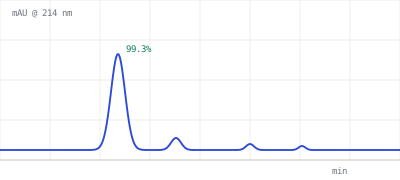
High-performance liquid chromatography with UV detection at 214 nm. Purity is reported as peak area normalization against total detected peak area. The full chromatogram is included on every COA — not just the number.
Identity by LC-MS
Liquid chromatography coupled to mass spectrometry confirms identity by comparing observed molecular mass against the theoretical mass calculated from the sequence. HPLC proves homogeneity; only MS proves identity.
Water activity
Measures unbound water available to drive hydrolysis and microbial growth, rather than total moisture. It is the figure that predicts how a lyophilized cake behaves in storage.
Endotoxin
Bacterial endotoxin by LAL, reported in EU/mg. Endotoxin survives processes that destroy the organisms that produced it, so it is measured directly rather than inferred.
Residual solvents
GC headspace screening for acetonitrile and trifluoroacetic acid residues from synthesis and processing, reported against recognized limits.
Elemental impurities
The category older documents call heavy metals. Elements enter from reagents, resins and contact surfaces rather than from the sequence, so purity by HPLC says nothing about them.
Net peptide content
The actual peptide mass in the vial by calculation, separate from bound water and residual solvent. This is the number your molarity calculations should use.
How to read it
A COA is only useful if you can verify it
Four things must appear before any result is reported: the lot number, the date of analysis, the method, and the laboratory that performed the work. A document missing any of the four cannot be checked against anything.
- Lot number matches the number printed on your vial
- Analysis date is recent, not the manufacture date
- The actual chromatogram is attached, not just a percentage
- Observed mass is shown beside theoretical mass
- Net peptide content is stated separately from gross mass
Where the work happens
Purified and finished in the United States
Chain assembly is performed by our manufacturing partner outside the United States. Every step after that — the steps that determine what is actually in the vial you receive — is performed at a contract laboratory in the US.
Pure peptide received
Assayed on arrival, before anything else is done to it. Material that fails intake is returned, not reworked.
HPLC purification
Performed in the US. This is the step that sets the purity figure printed on your certificate of analysis.
Lyophilization and vialing
Freeze-dried and sealed with desiccant, in a controlled environment.
Independent release testing
Third-party accredited assay, then released or rejected against our published specification.
What we do and don't claim
| Chain assembly | Outside the United States |
|---|---|
| Purification | United States |
| Lyophilization | United States |
| Vialing & sealing | United States |
| Release testing | United States |
Formulated and finished in the USA, not synthesized here. Solid-phase synthesis is performed overseas; purification, lyophilization, vialing and independent release testing are performed in the United States. We publish the precise version rather than the flattering one, on this and on everything else.
Document library
Current lot certificates
| Product | Lot | Purity (HPLC) | Identity (LC-MS) | Water activity | Endotoxin | Residual solvents | Elemental impurities | Net peptide | Status |
|---|---|---|---|---|---|---|---|---|---|
| BPC-157 | CR-1511 | 99% | Conforms | 0.21 aw | <1.0 EU/mg | Conforms | Conforms | 89.7% | Pass |
| TB-500 | CR-1408 | 98% | Conforms | 0.21 aw | <1.0 EU/mg | Conforms | Conforms | 82.3% | Pass |
| Wolverine Blend | CR-2526 | 98% (HPLC, each component) | Conforms | 0.21 aw | <1.0 EU/mg | Conforms | Conforms | 84.5% | Pass |
| GHK-Cu | CR-1575 | 99% | Conforms | 0.21 aw | <1.0 EU/mg | Conforms | Conforms | 93.8% | Pass |
| GLP-1 (S) | CR-2172 | 99% | Conforms | 0.21 aw | <1.0 EU/mg | Conforms | Conforms | 90.2% | Pass |
| GLP-2 (T) | CR-2189 | 99% | Conforms | 0.21 aw | <1.0 EU/mg | Conforms | Conforms | 83.1% | Pass |
| GLP-3 (R) | CR-2197 | 99% | Conforms | 0.21 aw | <1.0 EU/mg | Conforms | Conforms | 91.0% | Pass |
| MOTS-C | CR-1595 | 98% | Conforms | 0.21 aw | <1.0 EU/mg | Conforms | Conforms | 89.1% | Pass |
| Ipamorelin | CR-2072 | 99% | Conforms | 0.21 aw | <1.0 EU/mg | Conforms | Conforms | 86.1% | Pass |
| CJC-1295 (No-DAC) | CR-2165 | 99% | Conforms | 0.21 aw | <1.0 EU/mg | Conforms | Conforms | 83.4% | Pass |
| CJC-1295 + Ipamorelin Blend | CR-3237 | 98% (HPLC, each component) | Conforms | 0.21 aw | <1.0 EU/mg | Conforms | Conforms | 87.5% | Pass |
| Tesamorelin | CR-2187 | 98% | Conforms | 0.21 aw | <1.0 EU/mg | Conforms | Conforms | 93.8% | Pass |
| Epithalon | CR-1860 | 99% | Conforms | 0.21 aw | <1.0 EU/mg | Conforms | Conforms | 90.5% | Pass |
| NAD+ | CR-1804 | 99% | Conforms | 0.21 aw | <1.0 EU/mg | Conforms | Conforms | 82.3% | Pass |
| Glow Blend | CR-2003 | 99% | Conforms | 0.21 aw | <1.0 EU/mg | Conforms | Conforms | 89.4% | Pass |
| Klow Blend | CR-2007 | 99% | Conforms | 0.21 aw | <1.0 EU/mg | Conforms | Conforms | 93.8% | Pass |
Lot numbers rotate as inventory turns. The certificate supplied with your order always corresponds to the lot number printed on the vial you receive. Archived certificates for previous lots are available on request.
Quality FAQ
About our testing
An independent analytical laboratory, separate from the facility that synthesizes the material. The certificate is issued in that laboratory's name and we reproduce it exactly as issued.
Because an analysis performed by the party that made the material carries less weight than one performed by a laboratory with nothing at stake in the result. Most of this industry tests in-house and calls it quality control. Every lot we sell is assayed by someone with no interest in the answer.
It is not accepted into inventory. The certificate must carry the same lot number printed on the vials, be dated, and be legible. A generic or undated document is not a certificate.
Yes, and we encourage it for anything your results depend on. Send a sample to any accredited analytical laboratory. If an independent result falls outside the specification on the certificate we supplied, we refund or replace the material in full.
Sequence-specific stability guidance is published on each product page. Formal accelerated stability studies are available for institutional clients on request.
Caliper Research
Order material you can document
Every product ships with a batch-specific certificate of analysis tied to the lot number on your vial.